B2B Wholesale Distribution: How a 3PL Handles Pallet-Out and Bulk Orders
B2B Distribution Is a Different Animal Than D2C Fulfillment
Shipping 500 individual orders to consumers is a completely different operation than shipping 10 pallets to a retailer. B2B distribution involves larger order sizes, stricter delivery requirements, and retailer-specific compliance rules that most D2C-focused 3PLs aren’t equipped to handle. If you sell wholesale to retailers, distributors, or corporate buyers alongside your ecommerce channels, your fulfillment partner needs to handle both workflows from one warehouse.
MeisterPrep’s distribution services support both D2C and B2B fulfillment, so you don’t need separate warehouses for separate channels.
What B2B Distribution Actually Involves
A wholesale order from a retailer like Target, Costco, or a regional chain isn’t just “ship more units.” It comes with a vendor compliance guide that specifies exactly how the order must be packed, labeled, and shipped. Violate the guide, and you get chargebacks. Chargebacks range from $200 to $5,000+ per violation depending on the retailer.
Common retailer requirements for B2B distribution include:
- GS1-128 shipping labels on every carton and pallet
- Advance Ship Notices (ASN) sent via EDI before the shipment arrives
- Specific case pack configurations (exact number of units per inner pack and master carton)
- Delivery within a 2-day appointment window at the retailer’s distribution center
- Floor-loaded or palletized per the retailer’s specification (not your preference)
Miss any of these and the retailer deducts from your payment. Some sellers lose 5% to 10% of their wholesale revenue to chargebacks simply because their 3PL doesn’t follow the compliance guide.
EDI Integration
Most large retailers communicate through Electronic Data Interchange (EDI). Purchase orders arrive via EDI 850. You confirm with an EDI 855. You ship and send an EDI 856 (ASN). Then you invoice with an EDI 810. If your 3PL can’t handle EDI transactions, you’ll be doing manual data entry for every wholesale order. That’s slow, error-prone, and unscalable.
A 3PL set up for B2B distribution should either have native EDI capability or integrate with your EDI provider (SPS Commerce, TrueCommerce, etc.).
Pallet-Out vs. Case-Out vs. Unit-Level Fulfillment
B2B distribution operates at three levels depending on the buyer:
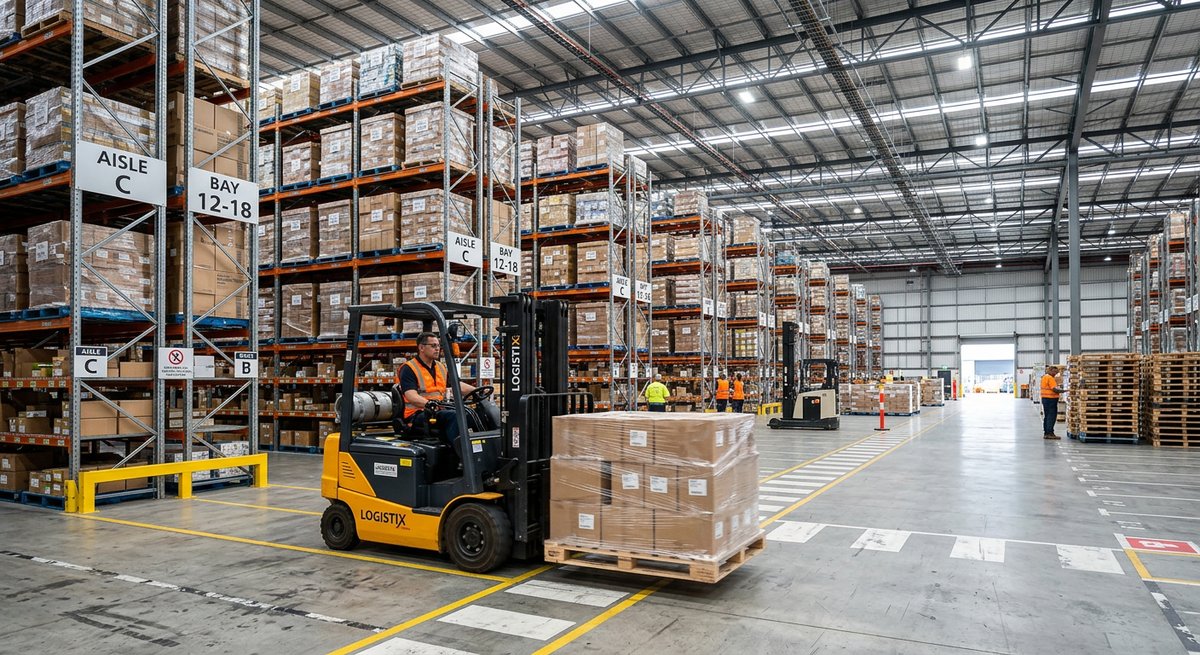
Pallet-out orders are the simplest. The retailer orders full pallets of a single SKU. Your 3PL pulls the pallet from storage, applies the required labels, and loads it onto a truck. Labor cost per unit is minimal because there’s no individual picking.
Case-out orders are more common. The buyer orders a mix of SKUs by the case. The warehouse picks the required cases from storage, builds a mixed pallet, wraps it, and labels it per the buyer’s spec. This requires more labor than pallet-out but less than individual unit picking.
Unit-level wholesale orders happen with smaller B2B buyers (independent retailers, corporate gift buyers, specialty shops). These look more like D2C orders but typically involve 50 to 500 units rather than 1 to 5.
Pricing for B2B Distribution
B2B fulfillment is typically priced differently than D2C. Instead of per-order pick-and-pack fees, you’ll see:
- Pallet-out handling: $5 to $15 per pallet
- Case picking: $0.50 to $1.50 per case
- Labeling (GS1-128 labels): $0.10 to $0.25 per label
- Palletizing and wrapping: $4 to $10 per pallet
- EDI processing: $1 to $3 per transaction or included in monthly minimums
The per-unit cost drops significantly at B2B volumes. Shipping 1,000 units as a pallet-out order might cost $0.03 per unit in handling. Shipping those same 1,000 units as individual D2C orders costs $2 to $4 each. That difference is why wholesale margins can be attractive even at lower selling prices.
Freight for B2B Distribution
D2C orders ship via parcel carriers (USPS, UPS, FedEx). B2B orders typically ship LTL (Less Than Truckload) or FTL (Full Truckload). The logistics are different.
LTL shipments require a Bill of Lading, NMFC freight class, and palletized goods. Transit times are 3 to 7 business days for domestic. FTL is faster and more cost-effective for large orders (10+ pallets) but requires a full truck booking.
Your 3PL should have relationships with LTL and FTL carriers to negotiate competitive rates. Some 3PLs mark up freight 15% to 25%. Others pass through carrier rates with a flat handling fee. Ask for the breakdown before you commit.
Running D2C and B2B from One Warehouse
The real advantage of a 3PL that handles both channels is inventory efficiency. Instead of splitting your stock between an FBA warehouse and a wholesale warehouse, you hold one pool of inventory. The WMS allocates units to D2C orders or B2B orders as they come in.
This reduces total inventory needed, lowers storage costs, and eliminates the risk of being overstocked in one channel while understocked in another. For sellers doing both Amazon and wholesale (which is increasingly common), this single-pool approach can free up significant working capital.
B2B Distribution Requires a Different Skill Set
If your 3PL only does D2C fulfillment, they’ll struggle with retailer compliance, EDI, pallet building, and LTL freight. If you’re growing into wholesale or already have retail accounts, choose a partner that handles both. The chargebacks from getting it wrong will cost more than the time spent finding the right provider.